

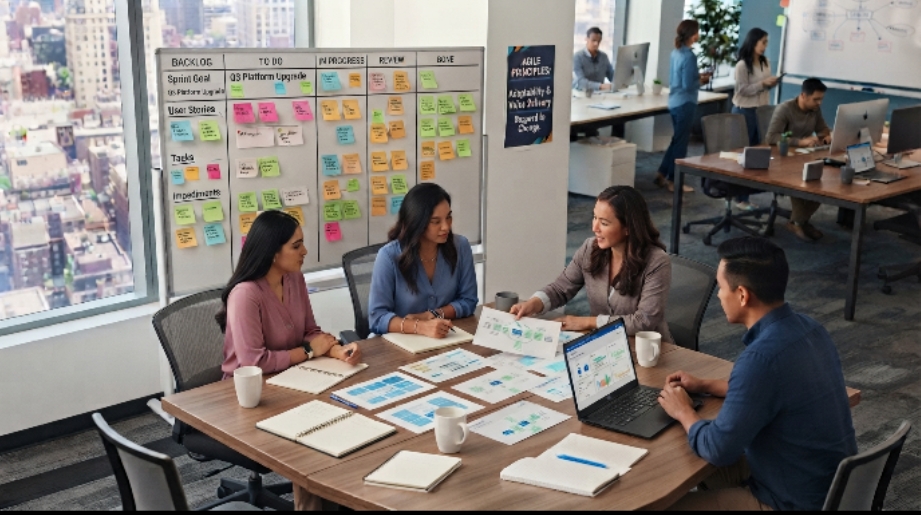
Project management is changing as businesses face shifting priorities, tighter deadlines, complex requirements, and rapidly developing technology. Because of this, many project managers are adding Agile skills to their existing knowledge. Agile Project Management Course helps teams respond to change, collaborate effectively, gather regular feedback, and deliver useful results throughout a project. Modern Agile frameworks are also evolving to address new delivery challenges. For project managers, learning Agile is not simply about following a different process. It is about developing practical ways to manage uncertainty, improve teamwork, and keep project delivery connected to customer and business needs.
Why Is Agile Project Management Becoming More Popular Among Project Managers?
Modern projects rarely remain the same from beginning to end. Customers may change requirements, businesses can introduce new priorities, and teams may discover unexpected challenges during delivery. Agile gives project managers a structured way to respond to these changes while maintaining project direction. Instead of treating the initial plan as completely fixed, teams can review progress regularly and adjust upcoming work.
Managing Changing Requirements
Changing requirements can create delays when teams are committed to rigid plans. Agile encourages teams to review priorities and respond to useful changes throughout delivery. Project managers can discuss new requirements with stakeholders and determine how they affect scope, resources, risks, and timelines. This allows teams to make controlled adjustments rather than continuing with assumptions that may no longer be relevant. The result can be a more responsive project environment where changes are considered as part of delivery instead of automatically being treated as disruptions.
Responding to Project Complexity
Projects involving multiple teams, stakeholders, technologies, and dependencies can be difficult to manage with a completely fixed approach. Agile helps teams address complexity through smaller work cycles, regular communication, and frequent reviews. Project managers can gain greater visibility into progress and identify issues earlier. Breaking larger objectives into manageable pieces can also make priorities easier to understand. Agile does not eliminate project complexity, but it gives project managers practical techniques for responding to uncertainty and adjusting delivery as new information becomes available.
Focusing on Value
Finishing a project on schedule does not always guarantee that it has delivered meaningful value. Agile encourages teams to consider whether their work is solving customer problems and supporting business objectives. Regular reviews allow project managers and stakeholders to evaluate whether priorities remain relevant. This creates a stronger connection between project activities and expected outcomes. Instead of measuring progress only by completed tasks, teams can also consider whether each increment contributes to something useful for customers, users, or the organisation.
What Skills Can Project Managers Develop Through Agile Project Management?
An Agile Project Management Course can help project managers develop practical skills beyond understanding sprints, backlogs, and stand-ups. It focuses on adaptability, collaboration, prioritisation, communication, feedback, and continuous improvement. These skills can also support professionals working in traditional or hybrid project environments.
Adaptive Planning and Prioritisation
Agile teaches project managers to keep plans flexible as priorities, customer needs, and project conditions change. Through an AgilePM Course, learners can develop the ability to prioritise work based on business value, urgency, dependencies, and available resources. Regular reviews help teams update plans using the latest project information.
Stronger Team Collaboration
Effective teamwork is essential for successful project delivery. Agile encourages regular communication between project teams, stakeholders, and customers. AgilePM Training can help project managers improve facilitation, clarify priorities, remove obstacles, and maintain alignment between different groups.
Feedback and Continuous Improvement
Agile teams use regular reviews and retrospectives to identify problems and improve their working methods. Project managers can learn to use real project feedback instead of relying only on assumptions made during initial planning.
Better Risk Management
Agile delivery provides frequent opportunities to identify technical issues, changing requirements, dependencies, and stakeholder concerns. This allows project managers to reassess risks earlier and adjust responses before problems affect a larger part of the project.
Why Are Agile Project Management Courses Valuable for Career Growth?
As organisations manage increasingly complex projects, professional development has become an important part of a project manager’s career. A structured AgilePM Training can help professionals understand Agile principles, planning, collaboration, delivery, and project governance in an organised way. For those looking for structured professional learning, Tecknologia offers project-management training designed to help learners develop practical knowledge from home or through suitable training options. This can be useful for professionals who want to strengthen their Agile knowledge alongside existing project-management experience.
Understanding the AgilePM Framework
An AgilePM Course can help project professionals understand how Agile principles can be applied within a project-management environment. Rather than focusing only on software development, AgilePM addresses areas such as project leadership, planning, stakeholder management, risk, and delivery. The latest AgilePM developments also place greater attention on value, Scrum integration, risk management, and multi-team projects. Understanding these areas can help project managers see how Agile practices can work alongside governance and project-management responsibilities.
Developing Recognised Professional Skills
Structured AgilePM Training provides professionals with a focused way to learn the framework and prepare for relevant assessments. Guided learning can be particularly useful for people who prefer a clear curriculum instead of studying disconnected resources online. Tecknologia provides professional training options for learners who want to build project-management skills and study in a structured environment. Combining formal learning with practical project experience can help professionals understand not only what Agile practices are, but also when and how to apply them effectively.
Keeping Agile Skills Relevant
Agile continues to develop as organisations respond to artificial intelligence, distributed teams, changing customer expectations, and complex delivery environments. Project managers therefore benefit from continuing to develop their skills rather than treating one qualification as the end of their learning journey. An Agile Project Management Course can provide a strong foundation, while real project experience helps professionals understand how Agile principles work in different situations. Continuous learning also makes it easier to adapt practices when project requirements, team structures, or organisational priorities change.
Applying Agile to Real Projects
An AgilePM Course can introduce a structured framework, but practical application is equally important. Project managers need to understand how to adapt Agile practices to their team’s size, project complexity, stakeholder expectations, and organisational environment. AgilePM Training can provide the theoretical foundation, while workplace experience helps turn that knowledge into practical capability. Learning through a provider such as Tecknologia can therefore be one part of a broader professional-development strategy that combines structured education, certification preparation, and hands-on project experience.
Conclusion
More project managers are learning Agile Project Management because modern projects often involve changing requirements, complex environments, tighter expectations, and a stronger focus on value. Agile provides practical ways to improve collaboration, adapt plans, gather feedback, and respond to uncertainty while maintaining project structure. Its principles can complement traditional and hybrid approaches rather than replacing them completely. For professionals, developing Agile skills can expand their project-management capabilities and prepare them for different delivery environments. Whether through structured training, practical experience, or both, the goal should be to understand Agile principles and apply the right practices according to each project’s objectives, people, risks, resources, and changing needs.
